The Vietnam opportunity
How I turned one question — should we commit to this market? — into a board-ready thesis: the evidence, the segments, the channels, and the partnership routes that would make the investment compound.
Reframing the market
The question on the table was deceptively simple: should the university commit recruitment resources to Vietnam, and if so, on what basis? I set out to build a proper market thesis, a single document a senior board could read in one sitting, challenge, and act on.
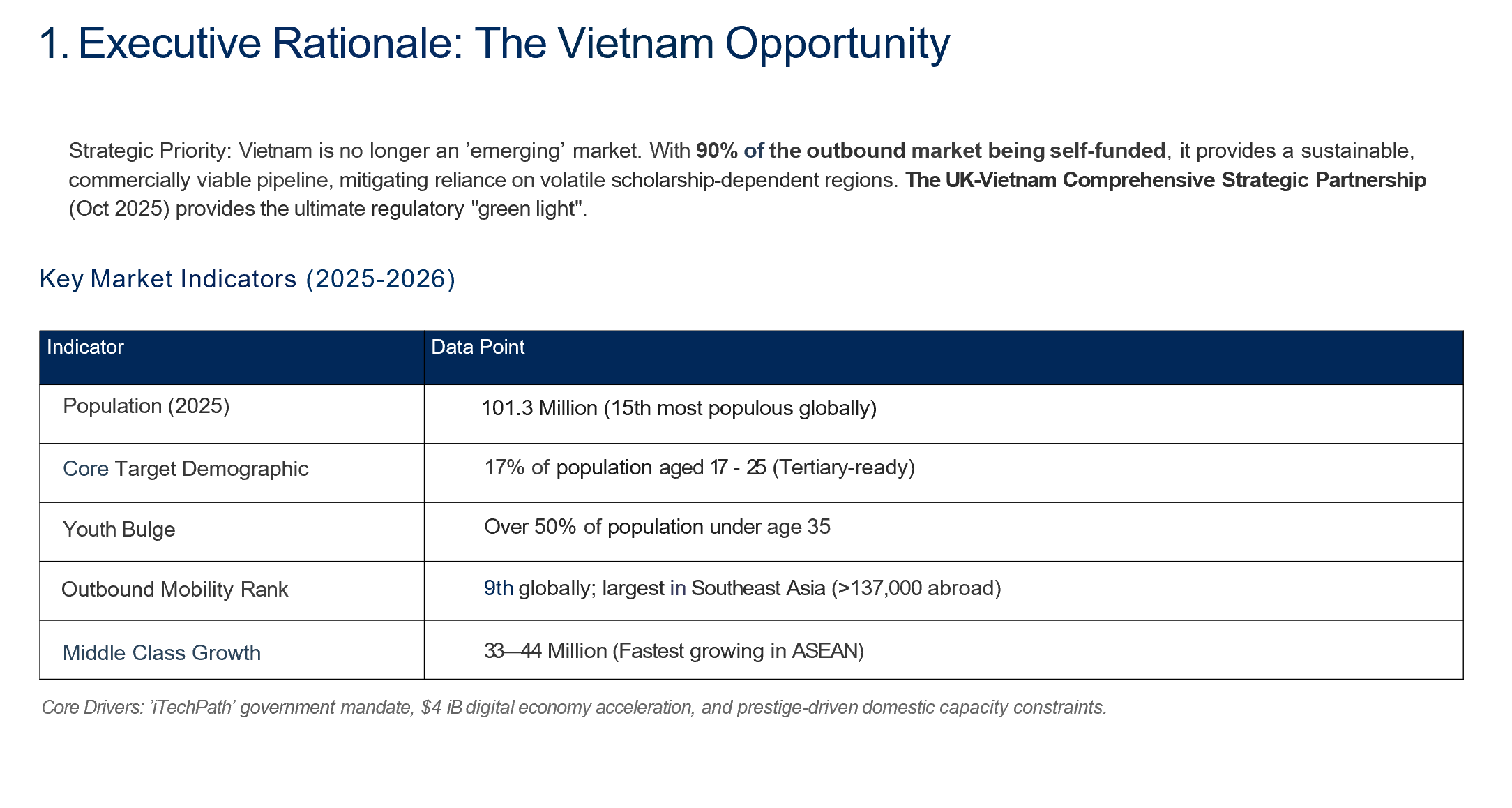
The first move was to reframe the market itself. Vietnam is still spoken of as ‘emerging’, but the figures tell another story: a population of 101 million, more than half under 35, and an outbound flow that is roughly 90% self-funded. I led with that reframe because it changes the whole investment logic — a self-funded pipeline is commercially durable in a way that scholarship-dependent markets simply are not.
Evidence before assertion
From there, the work was about evidence rather than assertion. I pulled together the demographic and mobility data, the regulatory backdrop, including the new UK–Vietnam Comprehensive Strategic Partnership and the British Council’s iTechPath initiative, and a clear-eyed read of the competitive field.
I mapped where the established players were already entrenched: Greenwich’s long-standing in-country alliance, the British University Vietnam model, Salford’s institutional networks, and the cluster of similarly ranked peers chasing exactly the same value-conscious students. Naming the competition honestly mattered; a board cannot weigh an opportunity it has not been shown the price of.
From data to a strategy you can run
The harder part was turning all of that into a strategy the institution could actually run. I built it in layers. First, priority segments — using the university’s subject strengths as ‘door-openers’ against national education priorities, and matching specific programmes in law, architecture, film and media, and psychology to genuine domestic demand.
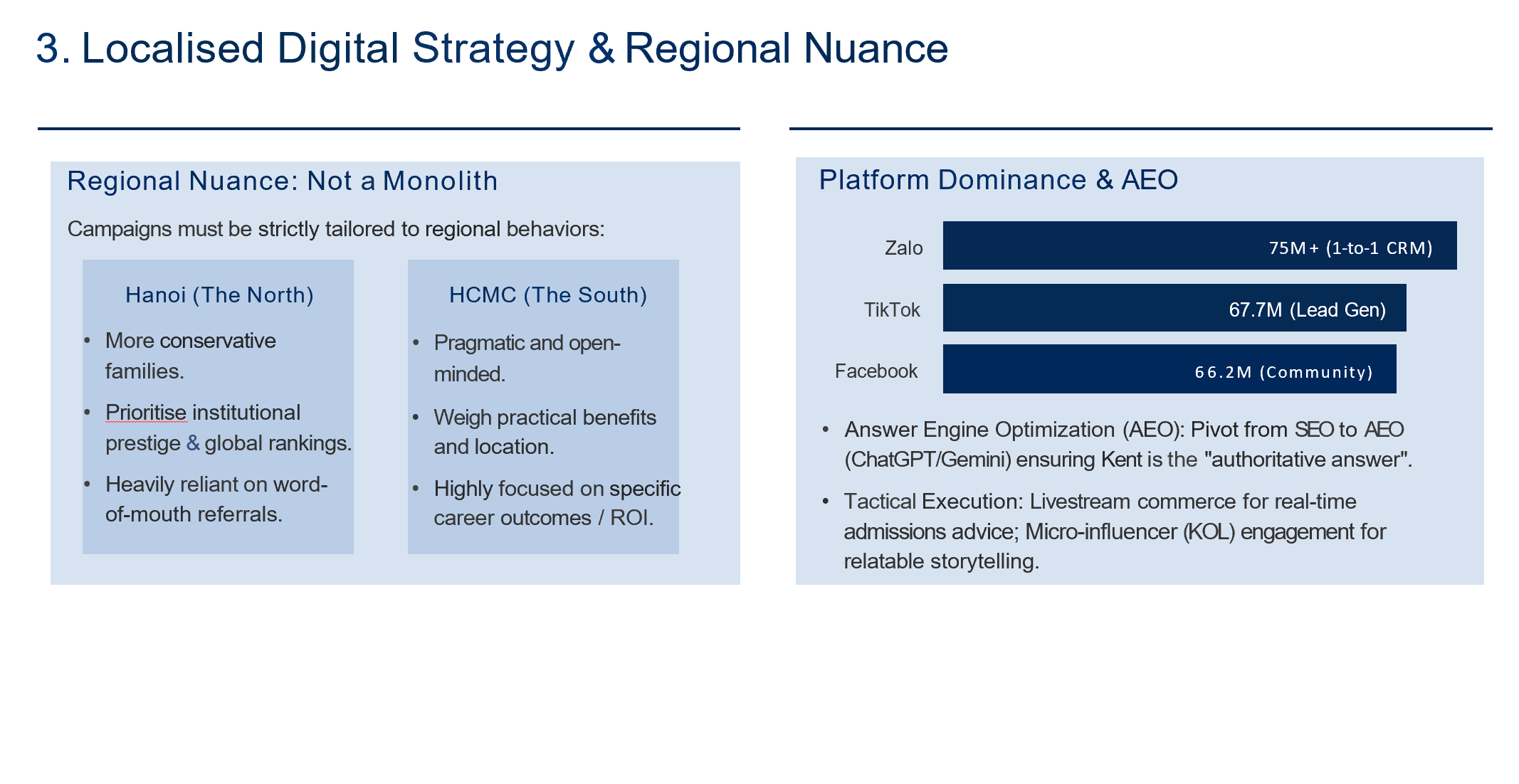
Second, a localised digital approach that treats Vietnam as three markets rather than one: the prestige-driven, word-of-mouth North against the pragmatic, return-focused South, delivered through the platforms that actually dominate there — Zalo, TikTok and Facebook — with a deliberate pivot from search-engine to answer-engine optimisation.
Where a partnership actually creates leverage
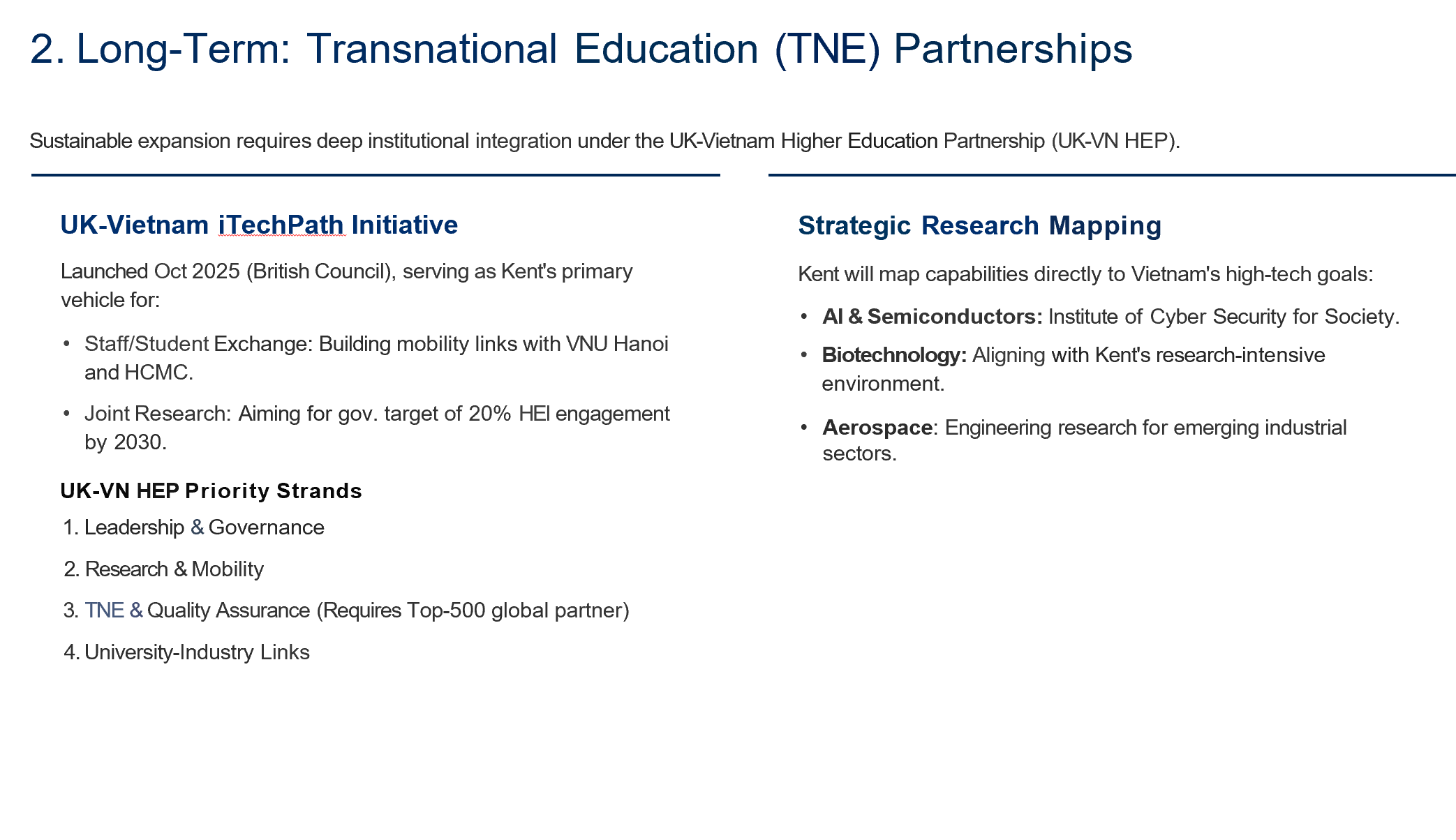
Throughout, I kept asking the question the board would ask: where does a partnership genuinely create leverage, rather than simply activity? That framing pushed the recommendation beyond agent recruitment and into deeper institutional integration — the kind of route that compounds, where each pathway alumnus, research tie and agent relationship feeds the next intake instead of resetting every cycle.
- Staff and student mobility with the Vietnam National Universities
- Joint research aligned to the national 2030 engagement target
- TNE delivery, with the quality-assurance groundwork a top-500 partner needs
- University–industry links across AI, semiconductors, biotech and aerospace
Built to be presented, not filed
I crafted the presentation to be engaging and actionable, not just a document to file away. It has a clear, decision-ready structure that includes the rationale, market segments, channel strategy, and long-term partnerships, with key indicators highlighted early to help senior leaders grasp quickly.
From this experience, I learned that defining a market opportunity requires disciplined synthesis: gather more evidence than needed but focus only on the critical factors that influence decision-making.